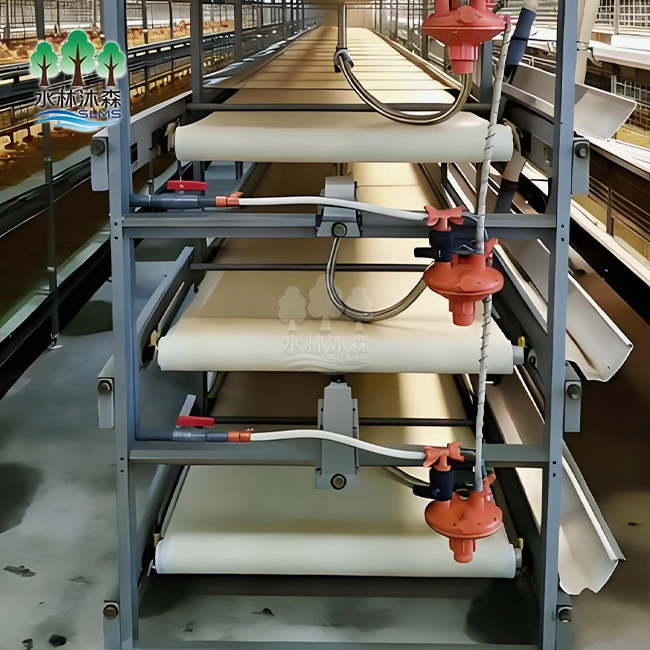
Compare features of automatic feeding trolleys for poultry farms
Understanding the differences between automatic feeding systems is important for buying choices when looking at modern ways to feed big flocks of chickens. A Poultry House Automatic Feeding Trolley is a high-tech electrical system that moves along the rows of cages and delivers the right amount of food with little help from a person. When compared to manual ways, these trolleys cut labor costs by over 40%. They also improve feed conversion rates by spreading feed out evenly, and they improve biosecurity by limiting the amount of time workers spend with herds. For farms with tens of thousands to hundreds of thousands of birds, picking the right type of Poultry House Automatic Feeding Trolley has a direct effect on how well the farm runs, how consistently it produces birds, and how much money it makes in the long run.


Key Features of Automatic Feeding Trolleys for Chicken Farms
Automated feeding systems today are a lot more complex than simple conveyor systems. Knowing the main features helps purchasing managers match the skills of tools with the needs and goals of each farm.
Control System Variations and Automation Levels
Depending on how the farm is managed, different control systems offer different levels of automation. Timer-based systems send feed at set times throughout the day, which makes them perfect for broiler farms that need to keep feeding plans consistent. Sensor-driven models have flow monitors and weight devices that change the rate of dispensing based on real-time data about usage. This stops overfeeding and waste. Remote-controlled models let workers start feeding cycles from centralized control rooms or cell phones, which is useful for farms with more than one house. Advanced models use all three methods together, mixing planned actions with sensor feedback and the ability to change them manually to be as flexible as possible.
Our engineering team at Shuilin Musen has seen that farms with more than 50,000 birds gain the most from systems that include sensors. This is because precise feeding cuts yearly feed costs by 8–12% compared to fixed-schedule options. The walking system with limit sensors makes sure that the Poultry House Automatic Feeding Trolley stops exactly where it's supposed to, which keeps people from getting hurt and extends the life of the machinery.
Feed Capacity and Structural Design
The size of the trolley bin is directly related to how efficiently it works and how often it needs to be refilled. Smaller units that can hold 80 to 120 kg work well for companies that use 3-layer cage systems that can hold 10,000 to 20,000 birds and need to be refilled every 4 to 6 hours. Medium-sized models (150–200 kg) can handle 4-layer setups with 30,000–50,000 birds, with breaks every 8–10 hours. Heavy-duty carts that can hold more than 250 kg are designed for big facilities with 100,000 or more birds and can run nonstop for 12 hours or more before they need to be refilled.
In corrosive chicken houses with ammonia levels of 25 to 50 parts per million, the life of the structure depends on how well it is built. When compared to standard powder-coated frames, hot-dip galvanized square and rectangular tubing with a zinc covering thickness of 275 g/m² is more resistant to rust. We use this galvanization process to build frames at Shuilin Musen. The frames have been shown to last 10 to 15 years, even in high-humidity duck houses with moisture levels above 75%. Instead of aluminum, the sheet material is made of high-zinc galvanizing steel, which is more resistant to being hit by cleaning tools or people.
Precision Dispensing and Anti-Jam Technology
Feed distribution uniformity is still an important performance measure that has a direct effect on the health of the flock and the stability of production. Professional-level carts keep the coefficient of variation below 2% at all feeding places, which makes sure that all parts of the cage get the same amount of food. This accuracy comes from variable-speed discharge devices that change flow rates based on trip speed. This keeps the fluid from clumping at slower speeds and not dispensing enough at faster speeds.
Feed bridging is a common problem that can be fixed with anti-jam features, especially in mash or high-moisture formulas. Hopper shapes with angles greater than 60 degrees encourage gravity-driven flow, and internal agitators break up feed that has become too compact. Overload safety systems stop operations automatically when barriers happen, sending out alerts instead of pushing motors past their safe limits. This protection makes the motor last 30–40% longer than motors that don't have this safety. Our models have emergency stop switches in several places along the trip path. This lets repair staff quickly shut down the machine if they see problems while it's running.
Energy Efficiency and Power Configuration
Operating costs include more than just the initial purchase price. They also include the amount of energy used every day for years of service. Power configuration choices significantly impact both installation difficulty and continued costs. While rail-powered systems get their power from overhead busbar contacts, they don't need batteries, but they do need to be installed by a professional electrician and have their contacts maintained on a regular basis. Battery-powered options work without wires and are easier to set up, but lead-acid batteries need to be replaced every 12 to 18 months, while lithium batteries last 3 to 5 years but cost more at first.
Different types of systems use different amounts of energy. In a 100-meter house, efficient models use between 0.8 and 1.2 kWh per feeding cycle. Older chain-based devices usually need between 1.5 and 2 kWh to work the same way. This difference adds up to 150–200 kWh saved each month, which is useful when you are in charge of more than one house. Specifications for geared motors are very important. Industrial-grade units with IP55 dust and moisture protection stay efficient longer than standard motors, which break down quickly in chicken houses.
Comparing Automatic Feeding Trolley Variants: Performance and Benefits
Before you can choose between trolley types, you need to know how the different specs affect how they work in real life. With comparative research, you can see which features give you the best return on investment for your farm.
Operational Efficiency Gains Versus Manual Methods
Two workers need to spend about three to four hours a day, or 1,095 to 1,460 hours a year, manually feeding 30,000 birds in a layer house. Poultry House Automatic Feeding Trolleys cut this time down to 30 to 45 minutes for tracking and restocking, which saves 85 to 90% of the work that would have been done by hand. For farms that pay $15 to 18 an hour, this means that each house will save $16,000 to $24,000 a year. When you multiply this by sites that run 6–12 houses, the time it takes to get your money back drops to 18–24 months.
Automating eating speeds up and makes sure that the quality of the food is always the same. Manual distribution naturally changes based on how tired the person is and how well they're doing their job. This leads to uneven consumption patterns that stress groups. No matter the weather or time of day, Poultry House Automatic Feeding Trolleys can feed the whole house in 20 to 35 minutes. They stick to a strict plan that helps digestion cycles and production rates work better.
Feed Wastage Reduction and Health Impact
Industry studies show that 8–15% of feed is wasted when animals are fed by hand because of spills, over-filling, and picking and choosing what to eat. Precision cart dispensing cuts waste to 3–5%, which immediately raises feed conversion rates. At current feed prices of $400 to $500 per ton, this 5 to 10 percent growth saves businesses that use 40 to 50 tons of feed every month $2,000 to $4,000.
Uniform feed delivery also takes health into account, which is something that is often forgotten when buying things. When you feed birds by hand, they become competitive eaters. The birds that are in charge eat a lot, while the birds that are below them don't get enough food. This causes flock weight differences of more than 20%. Automated systems that give all cage places instant access to feed lower weight differences to below 8%, which raises flock uniformity scores and market grade consistency. This uniformity means that the birds are less likely to get diseases, since birds that aren't getting enough food can spread diseases to whole homes.
Scalability Across Different Farm Sizes
Modular Poultry House Automatic Feeding Trolley designs let you plan for growth without having to update the whole system. Facilities that can hold up to 20,000 birds can install trolleys that are set up to work with their current plan. As they grow, they can add more cage tiers or make the houses longer while keeping the same equipment. Customization is very important in this case—trolleys need to be able to match the exact length, number of cage rows, and height of tiers of a chicken coop, so farms don't have to build their infrastructure around standard equipment.
At Shuilin Musen, we make Poultry House Automatic Feeding Trolleys that are exactly tailored to the needs of each customer and can carry houses that are 40 meters to 120 meters or longer. Because we work with both 3-layer and 4-layer stackable systems, farms can increase the number of crops they grow without having to replace their food equipment. This ability to adjust is important when market conditions call for more capacity, as it allows for capital-efficient growth that builds on past investments.
Installation, Maintenance, and Troubleshooting of Poultry Automatic Feeding Trolleys
Correct fitting and regular upkeep are both important for making sure that equipment works well. When procurement teams understand these operational aspects, they can better evaluate total ownership needs that go beyond buy specifications.
Site Preparation and Installation Protocols
A correct site survey weeks before the equipment arrives is the first step to a successful installation. To keep wheels from wearing out and the train from derailing, the supports for the track must be level and have a range of less than 3 mm per meter. Stable voltage within ±10% of standard is needed for electrical infrastructure because changes in voltage can damage motor windings and control boards. For battery-powered units, the charging station should be placed so that it is easy to get to without getting in the way of normal farm work.
Professional installation usually takes two to three days per house and includes fixing the tracks, calibrating the Poultry House Automatic Feeding Trolleys, and setting the control system. With each system, we include installation videos and detailed instructions so that skilled farm care workers can help set it up. For customers who want a full solution, on-site installation service is still available. This is especially helpful when adding trolleys to networks that already have silos and augers. Accurate delivery rates are set by proper initial testing, and test runs make sure that the food is distributed evenly before live birds are added.
Routine Maintenance Requirements
Schedules for preventative maintenance have a direct effect on how long equipment lasts and cut down on unplanned downtime. Once a week, the wheels, tracks, and hopper innards should be checked for feed buildup and to make sure they are in good shape. Food-grade oils should be used to grease drive chains and bearing points every two weeks to keep them from wearing out too quickly. This is especially important in dusty places where feather bits and calcium dust make friction worse.
Every month, maintenance checks the control system, makes sure the sensors are calibrated correctly, and looks for rust or loose electrical connections. Our walking system's sealed joints only need to be replaced once a year instead of being oiled all the time, which makes upkeep easier. Every six months, frame integrity checks find any new rust that needs to be fixed, but frames that have been properly galvanized rarely break down in the first ten years.
Cleaning practices are very important in places that care about hygiene. Using approved poultry-safe sanitizers to clean the whole Poultry House Automatic Feeding Trolley between flock rounds gets rid of the risk of pathogens spreading. The high-zinc galvanized sheet construction can handle harsh cleaning agents without losing its surface. This is in contrast to painting options that chip and rust after multiple cleaning processes.
Common Issues and Troubleshooting Approaches
Usually, moisture contamination, inconsistent particle size, or wrong hopper angles are to blame for feed jamming, which is the most common practical problem. When jams happen, workers should quickly press the emergency stop button, clear the way manually, and look for deeper problems like condensation drip points or changes in the feed formulation. If the jamming keeps happening after these fixes, it means that the hopper shape needs to be changed or a stirrer needs to be installed.
Sensor problems show up as uneven delivery rates or the end of the cycle too soon. Cleaning the sensors is the first step in troubleshooting because dust can get in the way of visual and capacitive sensing. If cleaning doesn't work, replacing the sensor with OEM parts makes sure that it works with the setting for the control system. When people try to fix things with non-certified parts, they often cause more problems that cancel warranties and raise the total cost of the work.
Cost and Procurement Considerations for B2B Clients
Strategic buying choices weigh the initial investment against the costs over the product's lifetime, the quality of service support, and how reliable the system is in use. Comparing values is easier when you know the total cost of ownership, not just the buying price.
Pricing Structure and Value Factors
The price of an Poultry House Automatic Feeding Trolley varies a lot depending on its size, how well it is automated, and how well it was built. Basic timer-controlled units for small tasks cost between $3,500 and $5,000. More advanced systems with sensors that can be monitored from afar cost between $8,000 and $15,000. Customization can add 10–25% to the base price, based on how complicated the specifications are. However, this investment makes sure that the equipment fits perfectly so that performance isn't compromised by being too small or too big.
To figure out the total cost of ownership, you have to add up the costs of installation ($800 to $1,500 for skilled service), maintenance supplies ($200 to $400 a year), and the amount of energy used over the predicted lifetime. At $0.12/kWh, a good train that runs for 15 years on 150 kWh of electricity per month costs about $2,700 in electricity. This isn't very much when you consider that over $200,000 in labor savings can be made in the same time period. Instead of choosing based only on price, procurement teams should ask sellers for lifetime cost analyses. This is because cheaper units usually need to be replaced within 5–7 years, while premium models last longer than 15 years.
Procurement Options and Supplier Evaluation
When buying in bulk for multiple locations or an equipment distributor's stock, you can usually get 15–25% off of the price of a single unit. Custom orders let specifications be matched to the exact needs of the farm, but lead times are longer—6–10 weeks instead of 2–3 weeks for normal setups. Some suppliers offer flexible financing plans that let you spread out payments over 24 to 36 months. This makes it easier for farms to handle their cash flow while replacing multiple systems at the same time.
When comparing suppliers, you should pay close attention to the warranty terms. Standard one-year coverage guards against problems with the way the product was made, but it doesn't usually cover wear parts like wheels and bearings. Options for extended warranties that last between 3 and 5 years add 10 to 15 percent to the purchase price, but they protect against unexpected repair costs during crucial production times. Access to spare parts is also very important. Suppliers who keep parts in stock in their local areas can send replacements within 24 to 48 hours, compared to two to three weeks for shipping them abroad.
The level of the service provided after the sale is what sets professional makers apart from commodity sellers. We offer technical help by phone and email, and we answer all questions within 4 to 8 work hours. Because our tech team has worked in this field for eight years, they can do accurate remote diagnostics that fix 70% of problems without having to visit the spot. When on-site help is needed, we work with partners in the area to keep downtime to a minimum, knowing that every day that a farm isn't running costs them $150 to $300 in lost production efficiency.
Conclusion
To choose the right automatic feeding systems, you have to weigh the technical requirements, operational needs, and lifetime costs against the way your farm is set up and your growth plans. Poultry House Automatic Feeding Trolleys with precise dispensing, strong construction, and full support help farms cut labor costs by more than 40%, improve feed efficiency by 8–12%, and extend the life of equipment by 10–15 years. Strategic buying doesn't just look at the price of a product; it also looks at the quality of the material, the ability to customize it, and the supplier's promise to provide help after the sale. When farms engage in the right automated feeding infrastructure, they gain a long-term competitive edge through lower running costs, more consistent production, and better biosecurity that protects flock health and farm profits.
FAQ
Q1: What is the typical lifespan of an automatic feeding trolley?
A: Poultry House Automatic Feeding Trolleys made of hot-dip galvanized steel that are of good quality usually last between 10 and 15 years in normal chicken houses. Lifespan varies a lot on the building materials used, how well they are maintained, and how corrosive the surroundings is. Standard designs don't work as well in duck houses with a lot of damp as units with properly sealed bearings and IP55-rated motors.
Q2: How much energy does a feeding trolley consume in standard operations?
A: How much energy a Poultry House Automatic Feeding Trolley uses depends on how much it can carry, how far it travels, and how the power system is set up. In a 100-meter house, efficient models use about 0.8 to 1.2 kWh for a full feeding cycle. Farms that do four to six feeding rounds a day use 100 to 200 kWh of power per trolley every month, which comes to $12 to 24 at standard business rates.
Q3: Can feeding trolleys be customized for different poultry types and cage configurations?
A: Professional manufacturers can make a lot of changes to the rack to fit the length, number of cage rows, and heights of the tiers of the chicken coop. Customization includes changing the hopper's size, the rate at which different types of feed are dispensed, and the programming of the control system to set feeding plans for each species. Higher-capacity, faster-cycle methods are better for broiler farms, while accurate dispensing is more important for layer farms. Because duck and turkey farms have higher wetness levels, the buildings they use need to be corrosion-resistant.
Partner with a Reliable Poultry House Automatic Feeding Trolley Manufacturer
Choosing the right food automation provider is the first step to improving operational efficiency and lowering long-term costs. Shuilin Musen Aquaculture Equipment Co., Ltd. makes perfectly designed Poultry House Automatic Feeding Trolley systems and has been doing so for eight years, always improving their products and making them better. Our hot-dip zinc construction means that they will last for ten years or more, and our ability to customize them means that they will work perfectly in a wide range of farm setups.
We back up your purchase with installation videos, setup services at your location, and a full 1-year guarantee that covers problems caused by production. When you have a technical question, our team answers it quickly and offers remote diagnostics and organized field help to keep downtime to a minimum. Email our experts at wangshuaislms@gmail.com to talk about your unique needs and get full specifications that are made to fit your operational goals. You can look at our whole line of products at slms-equipment.com and find out why top chicken farms trust Shuilin Musen for their food automation needs.
References
1. Appleby, M.C., Mench, J.A., and Hughes, B.O. (2004). Poultry Behaviour and Welfare. CABI Publishing, Wallingford, UK.
2. Czarick, M. and Lacy, M.P. (2009). "Mechanical Feeding Systems for Commercial Poultry Production." University of Georgia Cooperative Extension Bulletin 1322: 1-16.
3. Hartcher, K.M. and Jones, B. (2017). "The Welfare of Layer Hens in Cage and Cage-Free Housing Systems." World's Poultry Science Journal 73(4): 767-782.
4. Purswell, J.L., Dozier, W.A., and Branton, S.L. (2012). "Effect of Intermittent Lighting and Feed Allocation Programs on Broiler Performance and Sustainability." Journal of Applied Poultry Research 21(3): 610-618.
5. Tabler, G.T., Berry, I.L., and Mendenhall, A.M. (2003). "Mortality Patterns Associated with Commercial Broiler Production." Avian Advice 5(4): 1-3.
6. Yalcin, S., Özkan, S., Türkmut, L., and Siegel, P.B. (2001). "Responses to Heat Stress in Commercial and Local Broiler Stocks: Metabolic Traits." British Poultry Science 42(2): 149-152.
Learn about our latest products and discounts through SMS or email