Are negative pressure ventilators still used?
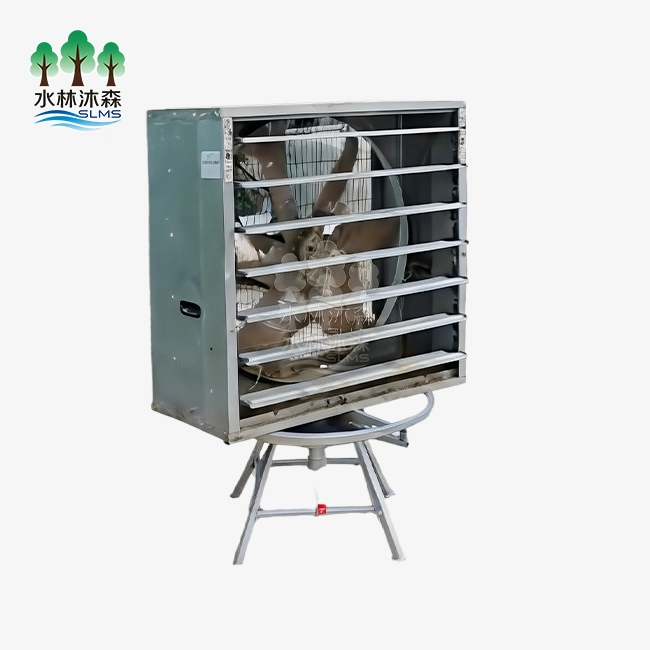
Without a doubt, negative pressure ventilators will still be used a lot in modern chicken and cattle farms in 2026. These ventilation systems are still the best for places where animals are raised in big groups, like chicken, turkey, and duck farms where controlling the environment has a direct effect on animal health and efficiency. Getting rid of old air automatically and letting in fresh air through controlled openings is how the Breeding House Negative Pressure Ventilation Fan solves three main problems: ammonia buildup, heat stress, and the spread of pathogens. Over the past ten years, this technology has changed a lot. It now has motors that use less energy, materials that don't rust, and automation features that are in line with modern farming methods that focus on both making money and taking care of animals.


Understanding Negative Pressure Ventilation in Breeding Houses
Negative pressure ventilation systems work by making a difference in the pressure inside farm buildings that are closed off. When exhaust fans take air out of a structure, the pressure inside drops below the pressure of the outside air. This forces fresh air into the structure through marked entry places like sidewall inlets or evaporative cooling pads.
How Pressure Differential Drives Airflow
Instead of mechanical air pushing, this technology is based on the laws of physics. When fans at one end of a chicken coop push air out of the house, air from outside comes in to fill the space. This makes wind patterns that can be predicted and controlled throughout the building. Negative pressure systems make sure that every cubic meter of entering air goes through filtration or conditioning systems before it reaches livestock. This is different from positive pressure systems, which push air in.
Environmental Control Benefits for Livestock
Proper air movement deals with several health risks at the same time. When airflow rates are equal to animal density and waste production, ammonia levels drop by a lot. When air gets in, it goes over evaporative cooling media before it hits birds. This makes temperature control possible even during the hottest part of summer. Controlling humidity stops lung infections and problems with litter wetness that hurt foot health. According to research from the University of Georgia Extension Service, feed conversion ratios are 15 to 20 percent higher on farms that have optimal airflow rates than on farms that don't.
Recognizing Poor Ventilation Warning Signs
Production managers should keep an eye on certain signs that show there isn't enough air flow. The smell of ammonia that you can smell when you walk into the building means that the amounts are higher than what is safe. Birds that breathe through their mouths open or gather near openings are showing signs of heat stress. Too much dust on objects means that air isn't moving around enough. It's possible for humidity to build up when walls get wet in cold weather. These signs usually show up slowly, which is why regular monitoring of the surroundings is necessary and not just a choice.
Evaluating Negative Pressure Ventilators vs. Alternative Ventilation Solutions
To pick the right ventilation technology, you need to know how different systems work in different building styles and working situations.
Negative Pressure System Performance Characteristics
Depending on the standing pressure inside the building, modern negative pressure fans can move between 28,000 and 38,000 cubic meters of air per hour per unit. A 50-inch industrial-grade unit can usually successfully cover 150 to 200 square meters of floor space. Fans that run all the time use an average of 1.1 kilowatts of electricity each day, which is equal to about 26 kilowatt-hours. When kept up properly, operational noise levels stay below 70 decibels, which keeps sensitive chicken species from reacting to stress. When made from corrosion-resistant materials that can handle high-ammonia conditions, the service life can reach 40,000 hours, which is about 4 to 5 years of constant use.
Tunnel Ventilation and Exhaust Fan Comparisons
Tunnel ventilation is a specific use of negative pressure that works best in buildings that are long and thin. With this set-up, several large fans are placed on one endwall, which speeds up the air along the length of the building to about 2.5 to 3.0 meters per second. While tunnel systems are very good at reducing heat stress in broiler production, they need major structure changes and work best in buildings that are longer than 150 meters.
Breeding House Negative Pressure Ventilation Fan systems, in contrast, are often used in smaller or more enclosed settings, but in this context, standard exhaust fans can remove air from specific areas without creating even movement, so they're better for adding to circulation than controlling the environment directly. Cross-ventilation systems spread the air out more evenly, but they don't cool as well as high air speeds do when it's hot outside.
Technology Advances Entering the Market
New improvements focus on smart controls and making the best use of energy. With variable frequency drives, fans can change speed based on real-time readings of temperature and humidity. This means that less electricity is used when the weather is mild and full capacity is maintained when the weather is extreme. Direct-drive motor designs get rid of the need to maintain belts, which makes them more reliable over time.
Fiberglass-reinforced polymer housings are better at resisting acidic breakdown than galvanized steel, which means that equipment will last longer in tough barn settings. IoT-enabled tracking systems let managers keep an eye on fan performance from afar, warning them of problems like worn bearings or motors that aren't working as well as they should be before they break down completely.
How to Select and Install a Negative Pressure Ventilation Fan for Your Breeding House
If ventilation equipment doesn't meet working needs or even causes new ones by not having enough capacity or distributing air inefficiently, it's because it wasn't properly sized and installed.
Calculating Airflow Requirements Accurately
How much air is needed depends on the size of the building, the number of animals, and the time of year. A building for laying hens that is 100 meters long, 12 meters wide, and 3 meters tall and holds 10,000 birds has 3,600 cubic meters of air space. For summer ventilation rates, air needs to be completely exchanged every 60 seconds. This means that the fans need to be able to move 3,600 cubic meters of air per minute, or 216,000 cubic meters of air per hour.
If you divide this need by the capacity of each fan (about 32,000 cubic meters per hour at working static pressure), you get that seven units would be enough to move the air. In the winter, ventilation rates drop to a tenth of what they need to be in the summer. To avoid over-ventilation in the winter, you need to use variable-speed settings or set up multiple fans.
Installation Best Practices and Standards
Where you put the fans has a big effect on how well they work. Mounting units at least one fan width apart stops air from flowing back and forth between exhausts that are next to each other. Putting fans 60 to 80 centimeters above the floor level helps air flow across all bird heights. For farm buildings, electrical systems must meet the National Electrical Code standards.
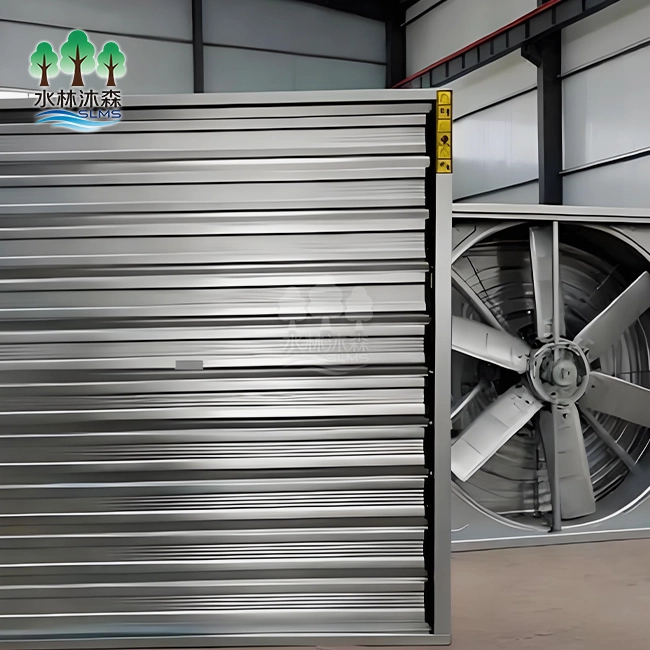
These include using conduit that doesn't get wet, protecting against ground faults, and making sure that the circuit breakers are the right size for the motor amperage. The structure should be able to hold the weight of the equipment (usually 80 kilograms per 50-inch unit) as well as the operating vibration loads. For shutter systems to fully open while fans are running and close tightly when the fans stop, they need to be properly counterbalanced. This stops backdrafts and light from getting in, which can throw off the circadian rhythms of birds.
Maintenance Protocols for Sustained Performance
Regular checks keep equipment in good shape and stop it from breaking down when you least expect it. Checking the shutter mechanism function, adjusting the belt tightness (for types that use a belt drive), and lubricating the bearings should all be done once a month. Cleaning the blades every three months gets rid of the dust that builds up and lowers the airflow by 10 to 15 percent.
Motors are inspected once a year to catch winding insulation degradation before it leads to catastrophic burnout. By keeping thorough repair logs, managers can find patterns, like faster bearing wear on certain units, that point to problems with the installation or the way the units are being used that need to be fixed.
Procurement and Supplier Insights for Negative Pressure Ventilation Fans
There's more to sourcing choices than just comparing the initial purchase price. The total cost of ownership includes things like installation help, the availability of spare parts, and the guarantee coverage, Breeding House Negative Pressure Ventilation Fan such as long-term maintenance and energy efficiency.
Evaluating Manufacturers and Authorized Dealers
Reputable companies that make ventilation equipment have established distribution networks with trained technical reps who offer advice before the sale, help with system design, and support after the installation. When compared to low-cost providers that don't have support infrastructure, companies that offer complete solutions like installation guides, detailed documentation in English, and helpful customer service lower the risks of implementation.
Professional-grade equipment is different from regular goods because it goes through quality control steps during production, like dynamic blade balancing to reduce vibration and salt spray tests for corrosion resistance. Asking for examples from current customers who run similar facilities can give you an idea of how reliable the product will be in the long term and how quickly the maker will respond to warranty claims.
Pricing Factors and Volume Purchase Considerations
Base equipment costs include things like motor strength, house materials, and how the blades are built. It costs around $450 to $650 per unit before installation for a normal 50-inch negative pressure fan with a 1.1-kilowatt motor, a stainless steel frame, and fiberglass blades. Customization requests, like housings made of stainless steel, motors that are explosion-proof for certain uses, or voltage needs that aren't standard, add 20–35% to the base price.
Facilities that need 20 or more units usually get 10-15% off and better payment terms when they sign a volume purchase deal. Integrated service packages that include equipment delivery, installation, and longer warranties give you peace of mind about your budget and make it easier to handle projects for large-scale operations by giving you a single point of responsibility.
Service Agreements and Warranty Terms
Standard maker warranties cover flaws in the materials and the work that was done. They usually cover new parts and labor for free for one year. Options for extended warranties that last between two and five years cost about 8 to 12 percent of the value of the equipment every year, but they keep you from having to pay a lot of money for new parts during busy production times.
Costs vary by location and the complexity of the building, but on-site installation services, such as those for a Breeding House Negative Pressure Ventilation Fan, ensure that everything is set up and running correctly. Maintenance contracts that include regular checks and faster emergency response are appealing to businesses that don't have their own professional staff or that are in charge of many sites in different places.
The Future of Negative Pressure Ventilators in Animal Breeding
The next wave of ventilation systems for intensive animal production is shaped by new technologies and changes in regulations.
Energy Efficiency and Smart Automation Integration
Modern motor designs that meet IE3 efficiency standards use 15-20% less power than older IE1-rated units. This saves a lot of money for equipment that runs for 8,000 hours or more a year. When ventilation equipment is connected to building control systems, it can react dynamically to temperature, humidity, ammonia concentration, and carbon dioxide levels, which means that it can change the rate of air exchange based on current conditions instead of set schedules.
Machine learning algorithms look at past performance data to guess what maintenance needs to be done before a part breaks. This changes the focus from fixes that are needed right away to planned actions that keep production running as smoothly as possible.
Environmental Sustainability and Regulatory Compliance
Agricultural environmental care is becoming more important, which is driving the use of ventilation systems that collect and clean exhaust air. Attached to negative pressure fan outlets, biofilter systems remove ammonia and chemical compounds before releasing air into the atmosphere. This stops neighbors from complaining and gets ready for tighter emission rules. Using energy-efficient tools lowers the carbon footprint of making power, which is in line with big poultry integrators' business sustainability promises. Environmental conditions in production sites are being looked at more and more as part of animal welfare audits. This means that reliable ventilation systems are needed to keep up with the standards for animal welfare that retail buyers demand.
Conclusion
Because it works well, keeps getting better, and can be used with a variety of building designs, negative pressure ventilation technology—exemplified by equipment such as the Breeding House Negative Pressure Ventilation Fan—is still the best way to control the environment in modern poultry and livestock businesses. The systems do a good job of dealing with basic problems like heat stress, harmful gas buildup, and disease control, which have a direct effect on animal health and the cost of production.
Specifications for equipment have changed over time to focus on making it last longer in corrosive settings, using less energy when the load changes, and working with digital farm management systems. When making purchases, companies have to weigh the initial investment against the long-term costs of running the business and the level of support their suppliers offer. This helps them stay profitable and meet new standards for safety and the environment.
FAQ
What differentiates negative pressure from positive pressure ventilation in poultry houses?
Negative pressure systems automatically let air out, which lowers the pressure inside the system and lets fresh air in through limited openings. This stops air from leaking out of control and makes sure that all entering air goes through filter or conditioning. Positive pressure systems force air into buildings, which can lead to uneven distribution and uncontrollable exhaust spots that make environmental control less accurate and efficient.
How many negative pressure fans does a house for 10,000 birds need?
The calculation is based on the size of the building and the air flow rates that are needed. During the summer, a normal 10,000-bird facility that is 100m x 12m x 3m (3,600 cubic meters) needs to share all of its air every minute, which means it needs a total capacity of about 216,000 m³/h. Seven units, each with a fan providing 32,000 m³/h at working static pressure, are enough to provide good air in the summer. In the winter, the rates can be lowered by using the controls.
Can existing poultry houses retrofit negative pressure ventilation systems?
Most standard chicken coops can be retrofitted with negative pressure with only minor changes. For some projects, you need to cut holes in the endwalls to install fans, add controlled air intakes along the sidewalls, and improve the electrical service so that it can handle multiple motor loads. Older buildings that don't have enough framing to support the weight of tools and the vibrations that come with operations may need structural strengthening. A professional evaluation figures out whether the repair is possible and whether it is cheaper to build something new.
Partner with Shuilin Musen Aquaculture Equipment Co., Ltd. for Reliable Ventilation Solutions
Weifang Shuilin Musen Aquaculture Equipment Co., Ltd. has eight years of experience creating and making air systems for settings with a lot of chickens and other animals. Our 50-inch Breeding House Negative Pressure Ventilation Fan moves 28,000 to 38,000 cubic meters of air per hour, is the most corrosion-resistant fan in its class, and has a lifespan of more than 40,000 hours.
Each unit successfully covers 150 to 200 square meters and comes with full installation videos, on-site setup help, and a one-year guarantee. Our research team makes sure that the motor power, housing materials, and control integration of each fan are exactly what your building needs. Email us at wangshuaislms@gmail.com to talk about how our Breeding House Negative Pressure Ventilation Fan supply options can help your business save money and make your flock healthier and more productive.
References
1. Donald, J. (2018). Poultry Production Systems: Environmental Management and Welfare. CAB International Publishing.
2. Lacy, M.P. & Czarick, M. (2020). Mechanical Ventilation Systems for Broiler Houses: Design and Management Principles. University of Georgia Cooperative Extension Bulletin 1318.
3. Bjerg, B., Rong, L., & Zhang, G. (2019). Computational Fluid Dynamics Analysis of Negative Pressure Ventilation in Livestock Buildings. Biosystems Engineering, 178, 274-291.
4. American Society of Agricultural and Biological Engineers. (2021). Design of Ventilation Systems for Poultry and Livestock Housing. ASABE Standards EP270.7.
5. Gates, R.S., Casey, K.D., & Wheeler, E.F. (2022). Fan Assessment Numeration System (FANS) Design and Calibration Specifications. BESS Laboratory Technical Report, University of Illinois.
6. National Chicken Council. (2023). Animal Welfare Guidelines and Audit Checklist for Broiler Chickens: Environmental Control Requirements. NCC Industry Standards Publication.
Learn about our latest products and discounts through SMS or email